

Selling a Clean York County Duplex: Why a Direct Sale Beats MLS Even Without Repair Friction

Updated: May 21

Most landlord-exit conversations start with condition — "my property needs work, so the MLS is off the table." This case looks at the opposite situation. What happens when the property is turnkey, the tenants are performing, and the owner wants out on a clean timeline? The common assumption is MLS nets more because the gross price is higher. The math usually says otherwise. This walk-through works the numbers openly on a composite York County duplex.
The Situation
What follows is a composite scenario — not any one owner, but a pattern the phones keep ringing about — worked openly end-to-end.
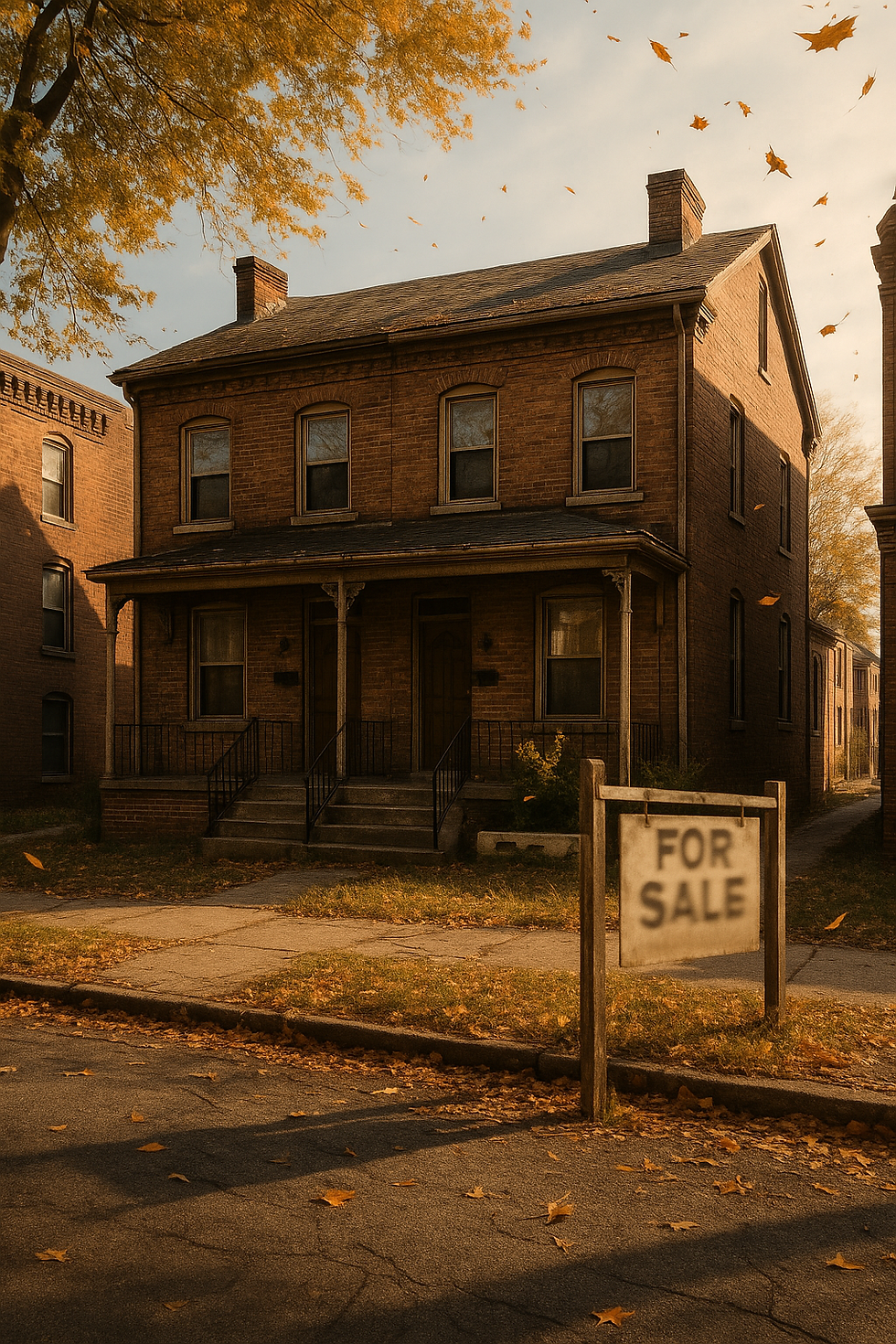
York County duplex, retail-comparable around $200,000 in turnkey condition.
Condition: appraisal-ready. Roof ~11 years old with 15+ left. HVAC replaced within 5 years. Copper plumbing. No active moisture, no structural issues.
Both units occupied. Unit 1: long-term tenant at $1,100/mo, 14 months left on lease. Unit 2: newer tenant at $1,050/mo, 9 months left on lease. Both pay reliably, both reasonable to deal with.
Landlord: owned 8 years, decided to consolidate out of small-multifamily to focus on a different sector. Wants net proceeds at closing — no monthly payments, no 5-year horizons. Would prefer to close inside 60-90 days.
Capital on hand for the exit: none needed. Property is clean; no pre-listing spend anticipated.
The owner's question: Is this worth listing on the MLS, or should I take a direct offer and move on?
The Financing Reality
Unlike a condition-compromised property, this duplex passes the appraisal test. An appraiser walking the property would likely rate it C3 — fully habitable, no deferred maintenance, ready to finance.
That single fact changes the buyer pool dramatically:
DSCR-financed investor buyers are available. A C3 rating with a stabilized rent roll is the profile DSCR underwriting is built for. The property's numbers pencil cleanly:
Gross annual rent: $2,150/mo × 12 = $25,800
Operating expenses (taxes ~$3,500, insurance ~$1,200, water/sewer if landlord pays ~$1,800, maintenance and vacancy reserves, management underwrite typical ~8%): approximately $11,150
Net Operating Income: approximately $14,650
At a typical York County cap rate range of 7.0–7.5% for stabilized 2-unit multifamily, an investor buyer prices the property roughly between $195,000 and $210,000.
Conventional owner-occupant buyers are partially available. An owner-occupant could qualify for the property if they intend to live in one unit. But the tenants' 9–14 months remaining on their leases prevent the owner from taking possession immediately, which thins this buyer pool meaningfully.
BRRRR / all-cash investors are available but at a steep discount. There is no reason an all-cash investor would pay market price on a clean property — they discount for speed and are outbid by DSCR-financed investors on properties like this one.
Takeaway: The buyer pool is wide, but the most competitive buyers are DSCR-financed investors (who can pay close to cap-rate-derived market) and retail MLS buyers (who pay off gross-price comparables). The question becomes: which of those actually nets the seller more?
The Four Paths Available to This Owner
Each panel below works the path openly. Numbers are rounded for readability; every specific deal will differ.
Path A — MLS Retail Listing at $200,000
Gross MLS sale price: $200,000
Pre-listing minor touch-ups (cleaning, paint in 1 unit, minor fixture refresh): − $4,000
Commission at 5.5% (buy + sell side, typical York County range 5–6%): − $11,000
Buyer concessions (typical 2–3% at closing): − $5,000
Holding costs during listing period (2–3 months insurance, utilities, lawn while under contract): − $3,500
Seller closing costs (transfer tax, title, misc.): − $2,000
Net to seller: approximately $174,500
Timeline: 90–150 days (listing, under contract, buyer financing contingency, close)
Tenant impact: Both tenants face showings during active listing period; leases transfer to the new owner regardless of whether the buyer is owner-occupant or investor.
Path B — Direct Sale to a DSCR-Financed Buyer at $195,000
Direct DSCR-financed sale price: $195,000 (mid-range of the $195K-$210K cap-rate band; investor prices conservatively to clear DSCR coverage)
No pre-listing repair or cosmetic spend: $0
No listing-side commission: $0
No holding carry (closes in about 6 weeks — lender underwriting plus settlement, sequential): $0
Typical seller closing costs: − $3,500
Net to seller: approximately $191,500
Timeline: approximately 6 weeks
Tenant impact: One walk-through for the buyer's evaluation. Leases transfer unchanged. Rent flow continuous, no showing disruption, no tenant notice cycle beyond the sale notice itself.
Path C — Seller-Financed Direct Sale
This owner explicitly wants net cash at closing, not monthly payments over five years. Seller financing does not fit the stated goal, even though the property could support it.
Shown for completeness: at $205,000 with 15% down, 6.5% rate, 20-year amortization, 5-year balloon, the seller would realize roughly $30,000 at closing, $78,000 in monthly payments over 60 months, and a balloon of approximately $144,000 at month 60. Total realized over 5 years: approximately $252,000 — meaningfully more than Path B in absolute dollars, but spread over five years and exposing the seller to default and interest-rate risk during that window.
When Path C would win for THIS owner: if the owner's goals shifted toward tax-advantaged monthly income (installment-sale treatment under IRC §453) or if a buyer materialized who could not qualify for DSCR but could carry a note.
When Path C does not win for THIS owner: the owner wants clean exit at closing. Path C is technically available, strategically wrong.
Path D — All-Cash BRRRR-Path Investor
On a condition-compromised property, Path D is the honest answer because the buyer pool reduces to cash investors and seller-financed deals. On THIS property — clean, DSCR-qualified, tenant-in-place — the Path D buyer has no advantage to offer and no reason for the seller to accept their discount.
Typical all-cash bid on a clean stabilized duplex: ~$170,000 (investor prices at a discount to DSCR-financed competitors to cover speed premium and capital cost)
Net to seller: approximately $166,500 (after seller closing costs)
Why this loses: the all-cash buyer is bidding against a DSCR-financed buyer who can pay $25,000 more. No speed or convenience advantage offsets that gap.
Side-by-Side Verdict
Path A — MLS at $200K gross
Net to seller: ~$174,500
Timeline: 90–150 days
Tenant impact: High (showings)
Cash at closing: Yes
Path B — Direct DSCR at $195K — WINNER
Net to seller: ~$191,500
Timeline: ~6 weeks
Tenant impact: Minimal (one walkthrough)
Cash at closing: Yes
Path C — Seller-Financed at $205K (5-yr)
Net to seller: ~$252,000 cumulative over 5 years
Timeline: 4–6 weeks to close + 5-year hold
Tenant impact: Minimal
Cash at closing: Partial (~$30K down at close, ~$222K over 5 years)
Path D — All-Cash at $170K
Net to seller: ~$166,500
Timeline: 2–4 weeks
Tenant impact: Minimal
Cash at closing: Yes
For THIS specific owner — clean property, performing tenants, cash-at-closing preference, 60–90 day timeline — Path B (Direct DSCR Sale) wins on every dimension the owner named. It nets approximately $17,000 more than the MLS path (Path A), closes in roughly one-third of the time, avoids the showing cycle that inconveniences both tenants and owner, and produces a lump-sum check at closing rather than a five-year income stream.
The MLS gross price looks higher on paper — $200,000 vs. $195,000 — but the MLS path surrenders approximately $25,500 to commission + concessions + minor prep + holding + closing costs. The direct DSCR path surrenders approximately $3,500 to closing costs, full stop. The $5,000 gross difference between paths is dwarfed by the $22,000 gap in friction cost.
Path B does not win on every property. On a condition-compromised duplex with deferred maintenance, the DSCR path is mechanically unavailable until repairs restore a C1-C4 appraisal rating. On a property where the owner wants income rather than cash-at-closing, Path C makes sense. On a property where speed matters more than price, Path D wins. The framework is the same in every case — condition narrows the buyer pool, the buyer pool determines the price, the owner's goals determine which available path fits best.
On THIS property, with THIS owner's goals, the honest answer is Path B.
What to Ask Yourself If This Case Sounds Familiar
If your situation resembles this one — a clean, tenant-occupied small multifamily and a goal of clean exit at closing — the following five questions sharpen the decision:
Have the property's operating numbers been documented recently? A DSCR-financed buyer needs a believable NOI to price the property; messy or missing records delay underwriting and often reduce the offer.
Are the current rents at market? Under-market rents reduce NOI and reduce a DSCR buyer's price. If rents have not been raised in several years, even a modest market adjustment at lease renewal can lift the investor-priced value meaningfully — worth considering before going to market.
What is the earliest realistic vacancy trigger on either lease? Tenant leases transfer to any buyer, but an owner-occupant retail buyer generally needs possession — so the remaining lease term affects which segment of the retail buyer pool is even available.
How much gross price difference would it take to make an MLS listing worth the friction cost? On this composite, Path A would need to clear approximately $217,000 gross just to match Path B's net. Is that realistic for the neighborhood comps?
Is the 60–90 day timeline a preference or a hard constraint? If it is a preference, the question is cost vs. convenience. If it is a constraint (relocation, portfolio deadline, tax-year consideration), the MLS path's variance is itself a risk worth pricing.
Related Reading
The full framework: download the free 2026 York County Landlord's Strategy Guide — walks all six exit paths, the financing mechanics behind each, and a worked case for a condition-compromised property where seller financing wins. Download the Guide
Selling with tenants in place: What the tenant's lease means for your sale
PA landlord-tenant law at sale: What Pennsylvania law requires when ownership changes
This case is a composite scenario intended to illustrate the framework, not a description of any specific property or owner. Every situation is specific; the numbers above are defensible as a reasonable York County mid-market example and are not a representation of any particular deal. This article is general information, not legal, tax, or financial advice. Before acting on anything here, talk to your own attorney, CPA, or financial advisor.
Want the Framework Applied to Your Property?
I am Ed Lane. I run Yellow House Buyers, LLC, and I am actively looking to buy 2-4 unit rental properties in York County directly from owners. I buy to hold long-term — not to flip, not to wholesale. If your situation resembles the one above (or the condition-compromised case in the main guide), the fastest way to know whether a direct sale is the right path is a 15-minute phone conversation.
Or download the free 2026 York County Landlord's Strategy Guide — it walks all six selling scenarios with the actual math.


Comments