

Selling a Paid-Off Triplex in York County at Retirement: Why Seller Financing Can Beat Cash at Closing

Updated: Jun 15

Most landlord-exit conversations assume the owner wants a lump-sum check at closing. That is the right goal for plenty of situations. It is not always the right goal. For an owner nearing retirement on a paid-off property with a low tax basis, a cash exit can trigger a tax bill that eats a quarter of the proceeds in a single year — and leaves a pile of cash that has to be redeployed to generate income. This case works the numbers when the owner's goal is monthly income instead of lump-sum cash.
The Situation
What follows is a composite scenario — not any one owner, but a pattern the phones keep ringing about — worked openly end-to-end.
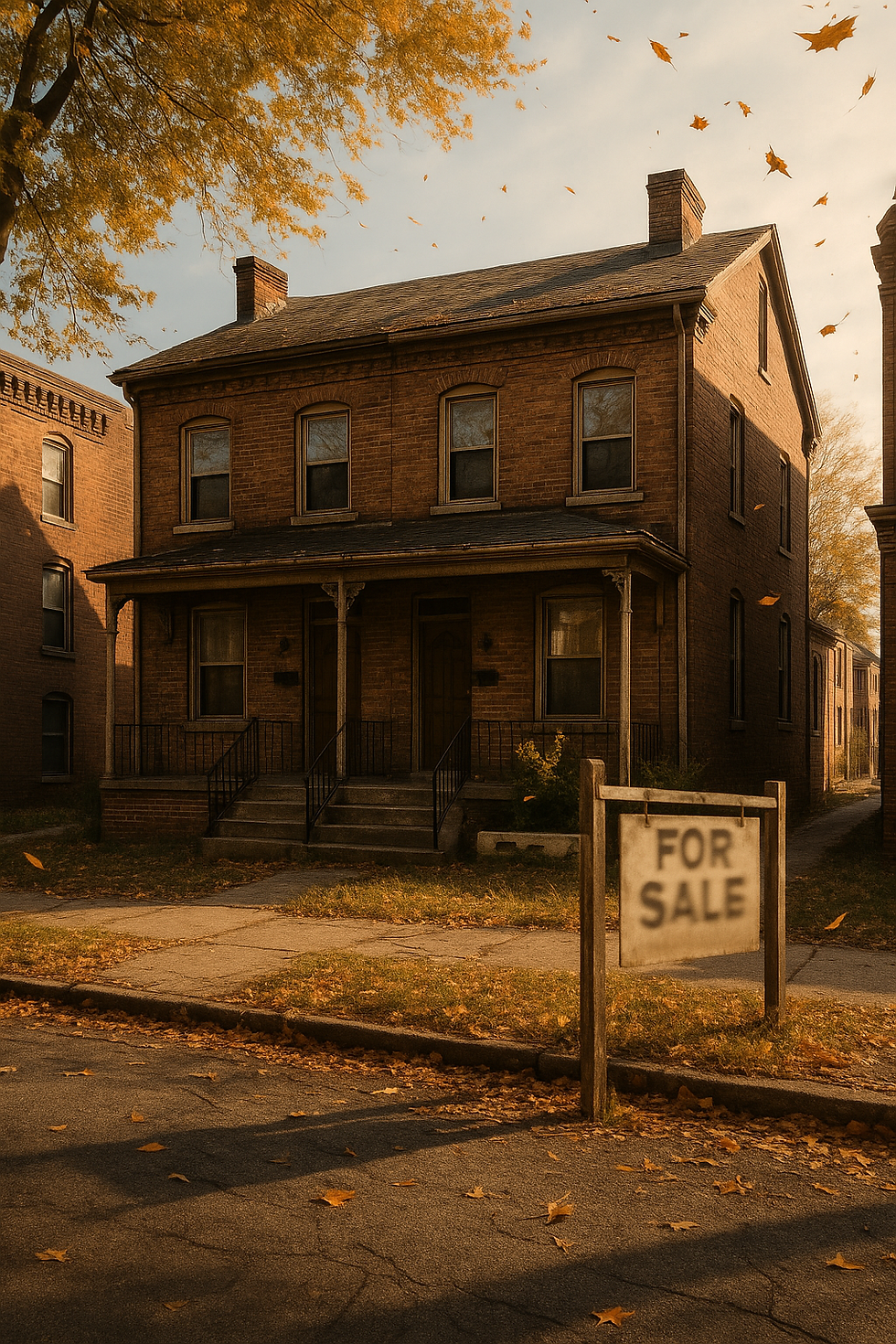
York County triplex, retail-comparable around $275,000 in current condition.
Condition: C3 appraisal-ready. Roof ~8 years old, HVAC serviced last year, copper plumbing, no deferred maintenance.
All three units occupied at modestly under-market rents (owner has not raised rents on long-term tenants). Unit 1: $1,000/mo (6 years), Unit 2: $950/mo (4 years), Unit 3: $900/mo (8 years). Gross: $2,850/mo, or $34,200 per year.
Landlord: 62 years old, owned the property 22 years, paid it off about 5 years ago. Planning retirement in the next 3–5 years. Wants to trade active landlording for passive income — specifically, monthly income that replaces a portion of working salary during retirement.
Tax basis: original purchase $95,000. Accumulated depreciation over 22 years: approximately $68,000 (on the depreciable basis). Adjusted basis today: roughly $27,000.
Capital-gain exposure if sold at $275,000: approximately $248,000 of gain, split between unrecaptured §1250 depreciation recapture (~$68,000 taxed at up to 25%) and long-term capital gain (~$180,000 taxed at 15–20% plus any state / net investment income tax layer).
The owner's question: Is it worth just selling for cash and paying the taxes, or is there a smarter way?
The Financing Reality
Unlike the condition-compromised case in the main guide, and unlike the clean-duplex case where Path B (direct DSCR) wins on friction math, this owner faces a different constraint: the property is financeable by anyone, but the owner's goals favor a specific path.
DSCR-financed investor buyers are available. At a typical York County cap rate range of 7.0–7.5% for stabilized 3-unit multifamily, the property prices roughly between $260,000 and $285,000 against its NOI of approximately $20,700.
Retail MLS buyers are available. The property is clean enough to pass appraisal; retail comps support the $275,000 range.
All-cash investor buyers are available but at the usual speed discount.
On the surface, the owner has the widest possible buyer pool. But the question is not "can I sell this?" The question is "which path fits my retirement plan best?"
Key mechanic: the capital-gain timing problem. Whichever path the owner takes, every path except seller financing recognizes the entire $248,000 gain in the year of sale. At blended federal rates (15–20% on the long-term capital-gain portion, 25% on the unrecaptured §1250 depreciation portion, plus applicable state and net investment income tax layers), the one-year tax bite could reach $55,000–$65,000, depending on the specifics. Confirm the actual numbers with a CPA — this is the critical variable.
Seller financing under IRC §453 (the installment-sale provisions) allows the seller to recognize the gain ratably across the years payments are received, rather than fully in the year of sale. That can materially lower the effective tax rate over the note's life by keeping the owner in a lower marginal bracket across multiple years and by spreading the §1250 recapture across the payment schedule. It also produces direct monthly income in the form of principal-and-interest payments — exactly what the owner said they want.
The Four Paths Available to This Owner
Each panel below works the path openly. Numbers are rounded; every specific deal will differ. Tax figures are illustrative — confirm with a CPA for your actual situation.
Path A — MLS Retail Listing at $275,000
Gross MLS sale price: $275,000
Pre-listing minor prep (paint, cleaning, minor repairs): − $5,000
Commission at 5.5% (buy + sell side): − $15,125
Buyer concessions at closing (typical 2.5%): − $6,875
Holding costs during listing (3–4 months): − $5,000
Seller closing costs (transfer tax, title, misc.): − $3,000
Net proceeds at closing: approximately $240,000
Estimated capital-gain tax in year of sale on $248,000 gain: − $55,000 to $65,000
After-tax net in year one: approximately $175,000 to $185,000
Timeline: 90–180 days
Tenant impact: Showing cycle affects all three tenants; leases transfer.
Path B — Direct Sale to a DSCR-Financed Buyer at $270,000
Direct DSCR-financed sale price: $270,000 (mid-band of the $260K–$285K cap-rate pricing)
No pre-listing spend, no commission, no concessions, no holding carry
Seller closing costs: − $4,000
Net proceeds at closing: approximately $266,000
Estimated capital-gain tax in year of sale on $243,000 gain: − $53,000 to $63,000
After-tax net in year one: approximately $203,000 to $213,000
Timeline: approximately 6 weeks
Tenant impact: One walk-through, leases transfer, rent flow continuous.
Path B nets meaningfully more than Path A after tax, and closes in roughly one-third the time — the same pattern the clean-duplex case demonstrated. If this owner's goal were a clean cash exit, Path B would win. But the owner's goal is retirement income, not a lump sum.
Path C — Seller-Financed Direct Sale at $285,000 (the winner for THIS owner)
Seller financing lets the owner sell at a modestly higher price because the buyer receives terms no institutional lender offers (lower down payment, no bank appraisal contingency, faster close, negotiable balloon structure). Those terms have real economic value to the buyer; the buyer is willing to pay a price premium for them.
Sale price: $285,000
Down payment (15%): $42,750 at closing
Seller-carried note: $242,250 at 6.5% interest, 20-year amortization, 10-year balloon
Monthly P&I to seller: approximately $1,807
Seller closing costs at closing: − $4,000
Cumulative seller proceeds over the 10-year note life (approximate):
Down payment at closing (minus closing costs): ~$38,750
120 monthly P&I payments ($1,807 × 120): ~$216,840
Balloon payment at month 120 (remaining principal): ~$183,000
Gross cumulative over 10 years: ~$438,590
Estimated tax profile over 10 years (illustrative — confirm with CPA): - Capital-gain portion recognized ratably as principal payments received (§453 installment sale treatment). - Interest income on the note taxed as ordinary income in the year received. - Effective blended tax rate over the 10 years is typically lower than the lump-sum rate because the gain is spread across multiple tax years, potentially keeping the seller in lower marginal brackets. - After-tax cumulative estimate over 10 years: approximately $340,000–$360,000. - Monthly after-tax income contribution during retirement: approximately $1,200–$1,400, depending on the tax bracket interaction with other retirement income.
Timeline: 4–6 weeks to closing; 10-year income stream thereafter.
Tenant impact: Minimal (same as Path B).
What the owner takes on: default risk if the buyer stops paying (mortgage remedies and foreclosure rights under PA law apply; see Section 11 of the main guide), interest-rate risk across the 10-year horizon, and the administrative overhead of collecting monthly payments (most owners route this through a note-servicing company for a small monthly fee).
Path D — All-Cash BRRRR-Path Investor
Typical all-cash bid on a clean triplex: approximately $220,000 (discount to DSCR-financed competitors — about 20% below market)
No speed advantage to offer over Path C, which closes at comparable speed
Net to seller at closing: approximately $217,000
Tax treatment: full gain recognized in year of sale, same as Path A
After-tax net in year one: approximately $160,000
Why this loses badly: the all-cash buyer has nothing to offer this owner. Speed is not scarce (Path B closes in ~6 weeks; Path C closes in ~4–6 weeks). The owner does not need a discount buyer.
Side-by-Side Verdict
Path A — MLS at $275K
Gross at close: $240,000 (after listing costs)
Timeline: 90–180 days
After-tax net Year 1: ~$175–185K
After-tax net Year 10 cumulative: ~$175–185K (lump sum, no further income)
Income stream: None
Path B — Direct DSCR at $270K
Gross at close: $266,000
Timeline: ~6 weeks
After-tax net Year 1: ~$203–213K
After-tax net Year 10 cumulative: ~$203–213K (lump sum, no further income)
Income stream: None
Path C — Seller-Financed at $285K — WINNER
Gross cumulative over 10 years: ~$438,000
Timeline: Mixed — partial at close, stream over 10 years
After-tax net Year 1: ~$35,000 at close (down payment minus closing & tax)
After-tax net Year 10 cumulative: ~$340–360K
Income stream: ~$1,800/mo gross for 10 years
Path D — All-Cash at $220K
Gross at close: $217,000
Timeline: 2–4 weeks
After-tax net Year 1: ~$160K
After-tax net Year 10 cumulative: ~$160K
Income stream: None
For THIS specific owner — paid-off property, low tax basis, 62 years old, retirement in 3–5 years, wants monthly income — Path C (Seller-Financed Direct Sale) wins on the dimensions the owner named. Over the 10-year horizon, Path C nets approximately $130,000 to $150,000 more than Path B after tax (this comparison assumes Path B proceeds are not reinvested; a 4% real return on the lump sum narrows the gap meaningfully — confirm with your CPA for your specific situation) — not because of a pricing trick, but because the installment-sale tax treatment materially reduces the effective tax rate and because the owner collects interest income over the note's life.
More practically: Path C converts a pile of taxable cash-at-closing into a structured monthly income during the retirement years — exactly what the owner said they wanted. Path B and Path A both produce a lump sum that then needs to be redeployed somewhere (bonds, dividend stocks, annuities) to generate retirement income, and that redeployment has its own costs and risks.
Path C does not win on every property. On the clean-duplex case (Case #1 in this series), the owner wanted net cash at closing; Path C was strategically wrong even though mechanically available. On the condition-compromised case in the main guide, Path C won because the property's C5 rating closed off Paths A and B — the buyer pool reduced to Paths C and D only. On this retirement case, Path C wins for a third reason: the owner's goals favor an income stream over a lump sum, and the tax mechanics reward that structure.
Same framework. Different owner, different property, different winning path — but the reasoning is always mechanical, not emotional.
What to Ask Yourself If This Case Sounds Familiar
If your situation resembles this one — a paid-off or near-paid-off rental property, approaching retirement, lower tax basis than current value, and a goal of replacing working income with rental-derived income — the following five questions sharpen the decision:
What is your adjusted tax basis in the property today? Original purchase price, minus accumulated depreciation, plus capital improvements. The lower your basis, the higher the gain at sale, and the bigger the tax-timing advantage of an installment structure. Your CPA can give you the exact number in ten minutes if you have your Schedule E history.
What is your marginal tax bracket in retirement likely to be? If you expect to drop from the 32% federal bracket during peak working years to the 22% or 24% bracket in retirement, timing capital-gain recognition into lower-bracket years produces real savings. If your retirement bracket will be the same or higher, the installment-sale benefit shrinks.
What monthly after-tax income do you actually need from this property? If you need $1,800–$2,200 per month in inflation-adjusted terms for 10+ years, the Path C math is worth running specifically for your situation. If you need $3,500 per month, the note from a single triplex will not cover it — you likely need either a larger property, a portfolio sale, or a different structure.
How do you feel about default risk? A well-structured seller-financed note with a qualified buyer, a meaningful down payment (10–20%), recorded mortgage, insurance loss-payee clause, and professional drafting is substantively protected. But "substantively protected" does not mean "risk-free." A buyer's business failure, health event, or property disaster is your exposure. Are you comfortable with that risk for 10 years?
What is your estate plan around a held note? A seller-carried note is a financial asset that passes to your heirs on death. Your estate plan should explicitly address: who inherits the note, who manages it, and whether they want the ongoing income or would prefer to sell the note on the secondary market. This is an attorney conversation, not a rental-property conversation.
Related Reading
The full framework: download the free 2026 York County Landlord's Strategy Guide — walks all six exit paths, with a worked case for a condition-compromised property where seller financing also wins (for different reasons than this one). Download the Guide
Companion case: Selling a Clean York County Duplex: Why a Direct Sale Beats MLS Even Without Repair Friction (the clean-property fast-exit archetype, where Path B wins instead)
Security and legal protections in seller financing: covered in Section 11 of the main guide, alongside what properly-drafted paperwork protects.
This case is a composite scenario intended to illustrate the framework, not a description of any specific property or owner. Every situation is specific; the numbers above are defensible as a reasonable York County mid-market example and are not a representation of any particular deal. Tax treatment under IRC §453 is specific to your individual facts — basis, gain composition, bracket trajectory, state treatment. This article is general information, not legal, tax, or financial advice. Before acting on anything here, talk to your own attorney, CPA, or financial advisor.
Want the Framework Applied to Your Property?
I am Ed Lane. I run Yellow House Buyers, LLC, and I am actively looking to buy 2-4 unit rental properties in York County directly from owners. I buy to hold long-term — not to flip, not to wholesale. For the right property and the right seller, I can structure as a DSCR-financed direct sale, a seller-financed purchase, or another path the fit calls for. The fastest way to know whether a direct sale is the right path for your situation is a 15-minute phone conversation.
Or download the free 2026 York County Landlord's Strategy Guide — it walks all six selling scenarios with the actual math.


Comments