

Selling an Inherited York County Rental: What the Heir Needs to Know Before Choosing a Path

Updated: Jun 15

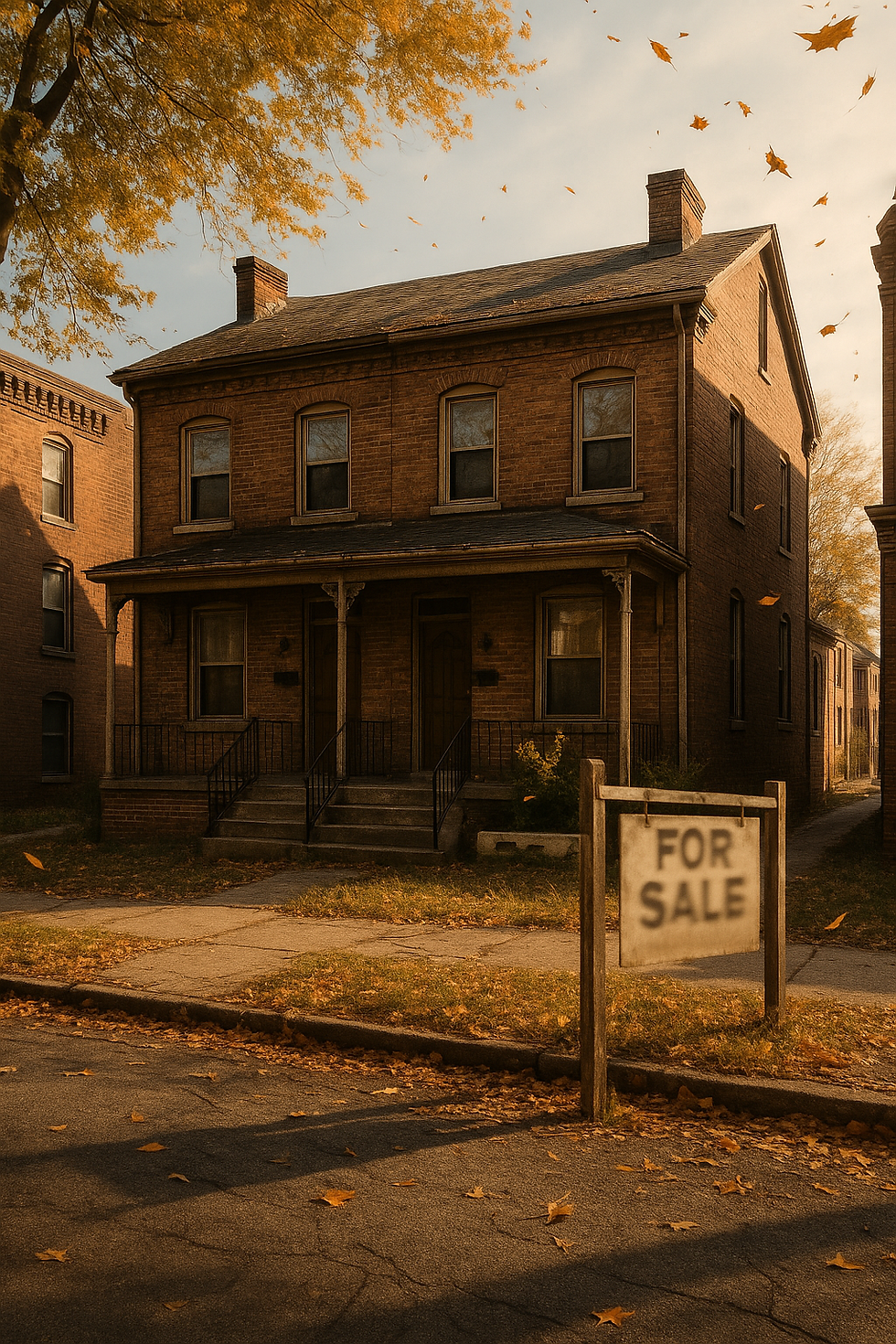
Inheriting a rental property is a mixed inheritance. It is an asset, but it is also an obligation — one the heir often has no experience with, no appetite for, and no local proximity to. This case works the math for a composite scenario that comes up often: a York County duplex inherited by an adult child who lives out of state, doesn't want to become a landlord, and wants to settle the estate cleanly. The four paths available produce different outcomes; the stepped-up basis rule (covered below) changes the tax calculus in a way that matters for choosing among them.
The Situation
What follows is a composite scenario — not any one heir, but a pattern that comes up regularly — worked openly end-to-end.
York County duplex, retail-comparable around $225,000 in current condition.
Condition: C2 appraisal-ready. The decedent parent kept the property well-maintained; roof is ~10 years old, HVAC was replaced 4 years ago, copper plumbing, no visible deferred maintenance, no open violations with the municipality.
Both units occupied. Unit 1: $1,050/mo (tenant has been there 3 years). Unit 2: $975/mo (tenant 2 years). Both pay reliably; the parent had good records, clear lease documentation, and a written rent-collection process.
Heir: 45 years old, lives in Denver, inherited the property roughly 4 months ago when the parent passed. Siblings split the residual estate; the property is to be sold and proceeds divided. The heir is the estate executor for practical purposes and has no brothers or sisters with capacity or interest in taking over the landlord role.
Heir's goals, in order: close out the estate within 6–9 months, net reasonable proceeds for division, minimize time spent managing a property from 1,500 miles away, and maintain the tenants' dignity through the transition — these are people the parent valued.
Heir's constraint: zero interest in becoming a long-term landlord, zero appetite for carrying a seller-financed note across 5–10 years, limited bandwidth for MLS logistics coordinated from Denver.
The heir's question: What is the right way to convert this property into proceeds without spending the next year of my life managing it from across the country?
The Financing Reality + Tax Reality
This case has two reality layers — financing (which buyer pool the property qualifies for) and tax (what happens when the heir sells) — and both differ from the prior cases in ways that matter for the path choice.
The property passes appraisal cleanly. An appraiser walking this duplex would rate it C2. The full buyer pool is available: - DSCR-financed investor buyers at a typical York County cap rate range of 7.0–7.5% on stabilized 2-unit multifamily. Annual NOI is approximately $13,800 (gross rents $24,300 minus ~$10,500 in operating expenses). That prices the property at roughly $185,000–$200,000 in an investor sale. - Retail MLS buyers (owner-occupant or small-investor) will pay off retail comparables at approximately $220,000–$230,000, subject to condition holding up in the purchase inspection. - Cash / BRRRR investors will bid at typical 25–30% discount for speed and risk assumption.
Here is where an inherited property differs from every other exit case: the heir's tax basis is the property's fair market value on the date of the decedent's death, not the decedent's original purchase price. This is the "stepped-up basis" rule under IRC §1014.
For this composite scenario, if the property was worth approximately $220,000 on the date of death, the heir's basis is $220,000 — regardless of what the parent paid for it years ago and regardless of accumulated depreciation the parent took. If the heir sells for $225,000 today, the taxable capital gain is only about $5,000 (the difference between sale price and stepped-up basis). At long-term capital gains rates, that is a minimal tax bill.
This flips the tax-timing argument that drives Case #2 (retirement installment sale). Where that case had a very low basis and high gain — making installment-sale treatment highly valuable — this case has a fully stepped-up basis and near-zero gain. There is no meaningful tax-timing benefit to stretching recognition across years. A lump-sum sale and an installment sale produce roughly equivalent total tax outcomes for an inherited property sold soon after inheritance.
Implication: Path C (seller financing) loses its biggest economic rationale on an inherited property. The remaining reasons to consider it — income stream, higher negotiated price — do not match this heir's stated goals.
Confirm all tax treatment with a CPA or estate attorney familiar with the decedent's specific situation. Step-up is general federal law; state treatment and estate-tax interactions vary.
The Four Paths Available to This Heir
Each panel below works the path openly. Numbers are rounded; every specific deal will differ. Tax figures are illustrative — confirm with a CPA for the specific estate.
Path A — MLS Retail Listing at $225,000
Gross MLS sale price: $225,000
Pre-listing minor prep (cleaning, paint touch-up, minor fixture refresh): − $3,000
Commission at 5.5% (buy + sell side): − $12,375
Buyer concessions at closing (typical 2.5%): − $5,625
Holding costs during listing (3–4 months of insurance, utilities the heir covers, property management): − $4,000
Seller closing costs: − $2,500
Net proceeds at closing: approximately $197,500
Estimated capital-gain tax (on ~$5,000 gain over stepped-up basis): − $1,000 or less
After-tax net: approximately $196,500
Timeline: 90–150 days
Heir logistical load: High. Coordinating agents, showings, inspection responses, tenant access, buyer financing contingencies — all from Denver. Typical listing cycle requires multiple heir decisions on short notice.
Path B — Direct Sale to a DSCR-Financed Buyer at $195,000
Direct DSCR-financed sale price: $195,000 (upper end of the cap-rate-derived band, reflecting that the property is clean and well-documented)
No pre-listing spend, no commission, no concessions, no holding carry
Seller closing costs: − $3,500
Net proceeds at closing: approximately $191,500
Estimated capital-gain tax: minimal (near-zero gain over stepped-up basis)
After-tax net: approximately $191,500
Timeline: approximately 6 weeks
Heir logistical load: Low. One walk-through for the buyer, then heir coordinates with the title company from Denver. Leases transfer unchanged to the new owner; tenants receive standard transfer notice through settlement.
Path C — Seller-Financed Direct Sale
Briefly shown for completeness: seller financing is technically available, but does not fit this heir's goals.
The heir has explicitly named "close out the estate" and "minimize time spent managing from Denver" as priorities. A seller-carried note requires 5–10 years of ongoing involvement — collecting payments, handling defaults, managing the administrative layer of a note that runs concurrently with the heir's real life. That is the opposite of what the heir wants.
The tax benefit that drives seller financing on long-held property (§453 installment-sale treatment spreading gain across years) has essentially zero value here. The stepped-up basis already eliminated the gain.
Seller financing also does not clean-exit settle the estate for the siblings. They would be splitting a note with principal tied up, not proceeds from a closed sale.
Verdict on Path C for this heir: mechanically available, strategically wrong. Skip.
Path D — All-Cash BRRRR-Path Investor at $165,000
Typical all-cash bid on a clean duplex: $165,000 (approximately 25–27% discount to retail)
Seller closing costs: − $2,500
Net proceeds at closing: approximately $162,500
Estimated capital-gain tax: minimal
After-tax net: approximately $162,500
Timeline: 2–4 weeks
Heir logistical load: Minimal. Fastest close of the four paths.
What the heir gives up for the speed: approximately $29,000 vs. Path B and approximately $34,000 vs. Path A. That is the speed premium — roughly 20% of after-tax proceeds — paid in exchange for closing 2–4 weeks sooner and with somewhat less due-diligence friction.
Side-by-Side Verdict
Path A — MLS at $225K
Net (after tax): ~$196,500
Timeline: 90–150 days
Heir effort: High (Denver coordination required)
Tenants: Disrupted (showings during listing)
Path B — Direct DSCR at $195K — WINNER
Net (after tax): ~$191,500
Timeline: ~6 weeks
Heir effort: Low (title-company coordination from Denver)
Tenants: Preserved (lease transfers unchanged)
Path C — Seller-Financed
Not a fit for this heir: 5–10 years of ongoing involvement
Tax-timing benefit eliminated by stepped-up basis rule
Heir effort: Ongoing
Tenants: Preserved
Path D — All-Cash at $165K
Net (after tax): ~$162,500
Timeline: 2–4 weeks
Heir effort: Minimal
Tenants: Preserved
For THIS specific heir — out-of-state, time-constrained, no landlord ambition, stepped-up basis eliminating the tax-timing argument, siblings waiting for proceeds — Path B (Direct DSCR Sale) wins on the balance of net and logistical load. It nets only ~$5,000 less than the MLS after tax while eliminating 3+ months of cross-country coordination, inspection theater, and buyer-financing uncertainty. For an heir managing the property from Denver, that $5,000 difference is almost always worth paying for the 60–90 day reduction in the logistical burden.
Where Path D would win instead
Path D becomes the right path if closure speed is worth more to the heir than the $29,000 gap vs. Path B. That calculation is personal, not mechanical. Situations where it tends to tip toward Path D: - The estate is holding up other financial decisions for the heir or siblings (student loans being refinanced, a home purchase pending, a CPA waiting to close out the final estate return). - The heir is in grief and the property itself is a continuing source of emotional weight. - The property is generating ongoing carry costs the heir is personally covering (insurance, property tax installments, utility gaps) — and those carry costs over a 6-week Path B timeline vs. a 3-week Path D timeline add up. - There is family disagreement among siblings about the disposition, and a faster close reduces the window for disagreement to escalate.
Where Path A would win instead
Path A starts making sense if: - The heir has the bandwidth (or a local property manager) to coordinate from out of state for the full listing cycle. - The local market is unusually strong for the property type — regularly selling well above cap-rate-derived value to retail buyers. - The tenants are easy to coordinate with, or both units happen to be vacating during the listing window (removing the tenant-showing friction entirely).
Path B is the default answer for most inherited-property situations where the property is clean and the heir wants out cleanly. Path D is the right answer when the heir will genuinely pay $29,000 for 3 weeks of their life back. Path A is the right answer when the heir's bandwidth matches the listing cycle's demands. Path C is almost never the right answer for an inherited property, because the stepped-up basis removes the main economic rationale.
Same framework as the other cases. Different inputs. The winning path is the one whose inputs match the heir's actual situation — not the one with the highest gross price.
What to Ask Yourself If This Case Sounds Familiar
If you inherited a rental property in York County and the situation above resembles yours, the following five questions sharpen the decision:
Do you know the property's fair market value on the date of the decedent's death? The executor or estate attorney typically obtains a date-of-death appraisal. If you do not have one on file, get it before you sell — it establishes your tax basis and protects you from IRS questions about the capital-gain calculation later.
What is the estate's timeline for settlement? If the estate is otherwise ready to close out and the property is the last open item, speed has real value. If the estate has other unresolved matters requiring time anyway, a slightly longer sale path (Path A or Path B) may not cost anything meaningful.
Do you have a local point person? A local real estate attorney, a property manager, or a trusted family friend who can physically attend the property for any walk-through or documentation need reduces the cross-country logistical load dramatically. If you do not, the logistical cost of Path A rises substantially.
Are the tenants people the decedent respected? Many inherited-property sellers feel a responsibility to tenants their parent or relative chose carefully. A direct sale to an investor buyer (Path B) with lease continuity is usually the smoothest outcome for the tenants; an MLS listing with owner-occupant buyers often ends in the tenants being asked to leave at lease expiration. Worth naming as a factor if it matters to you.
Have you actually computed the after-tax proceeds under each path, accounting for the stepped-up basis? Many heirs assume selling will trigger a large tax bill (because their parent had held the property for decades). The stepped-up basis rule typically eliminates that concern. Confirm with a CPA — the result can change which path makes sense.
Related Reading
The full framework: download the free 2026 York County Landlord's Strategy Guide — walks all six exit paths, with a worked case for a condition-compromised property where seller financing wins. Download the Guide
When the property is clean and the owner wants fast cash: Selling a Clean York County Duplex: Why a Direct Sale Beats MLS Even Without Repair Friction (Case #1)
When the owner wants retirement income, not a lump sum: Selling a Paid-Off Triplex in York County at Retirement: Why Seller Financing Can Beat Cash at Closing (Case #2)
PA landlord-tenant law at sale: What Pennsylvania law requires when ownership changes
This case is a composite scenario intended to illustrate the framework, not a description of any specific property or heir. Every situation is specific; the numbers above are defensible as a reasonable York County mid-market example and are not a representation of any particular deal. The stepped-up basis rule and installment-sale tax treatment have specific technical requirements that vary by state and by estate; nothing in this article is legal, tax, estate, or financial advice. Before acting on anything here, talk to your own estate attorney, CPA, or financial advisor — ideally one of each, working from your specific estate documentation.
Want the Framework Applied to Your Inherited Property?
I am Ed Lane. I run Yellow House Buyers, LLC, and I am actively looking to buy 2-4 unit rental properties in York County directly from owners and heirs. I buy to hold long-term — not to flip, not to wholesale. For an inherited property, I can typically close in about 6 weeks, keep existing tenants in place with their leases unchanged, and coordinate entirely with you through the title company if you are out of state. The fastest way to know whether a direct sale is the right path for your specific estate is a 15-minute phone conversation. If it is not the right fit, I will tell you — and where I can, I will point you toward the path that is.
Or download the free 2026 York County Landlord's Strategy Guide — it walks all six selling scenarios with the actual math.


Comments